

__24C05D67dI.webp)
2026-08-24
SSD University
Do You Need Enterprise SSDs for RAID? Key Considerations for Choosing SSDs for RAID Applications
RAID (Redundant Array of Independent Disks) is widely used in servers and storage systems to improve data protection and performance. As SSDs increasingly replace traditional HDDs as the primary storage media in servers and NAS systems, the type of SSD can directly affect the real-world performance and reliability of a RAID system. Does RAID necessarily require enterprise SSDs, or can consumer SSDs also do the job? RAID does not necessarily require enterprise SSDs, but the SSDs must meet the workload and reliability requirements of the system. For most mission-critical applications, enterprise SSDs are generally the more reliable choice. This article examines the role and value of enterprise SSDs in RAID applications from the perspectives of RAID characteristics, SSD workloads, and risk considerations.
Understand the principles and differences of different RAID levels: What Is RAID? How to Build SSD RAID?
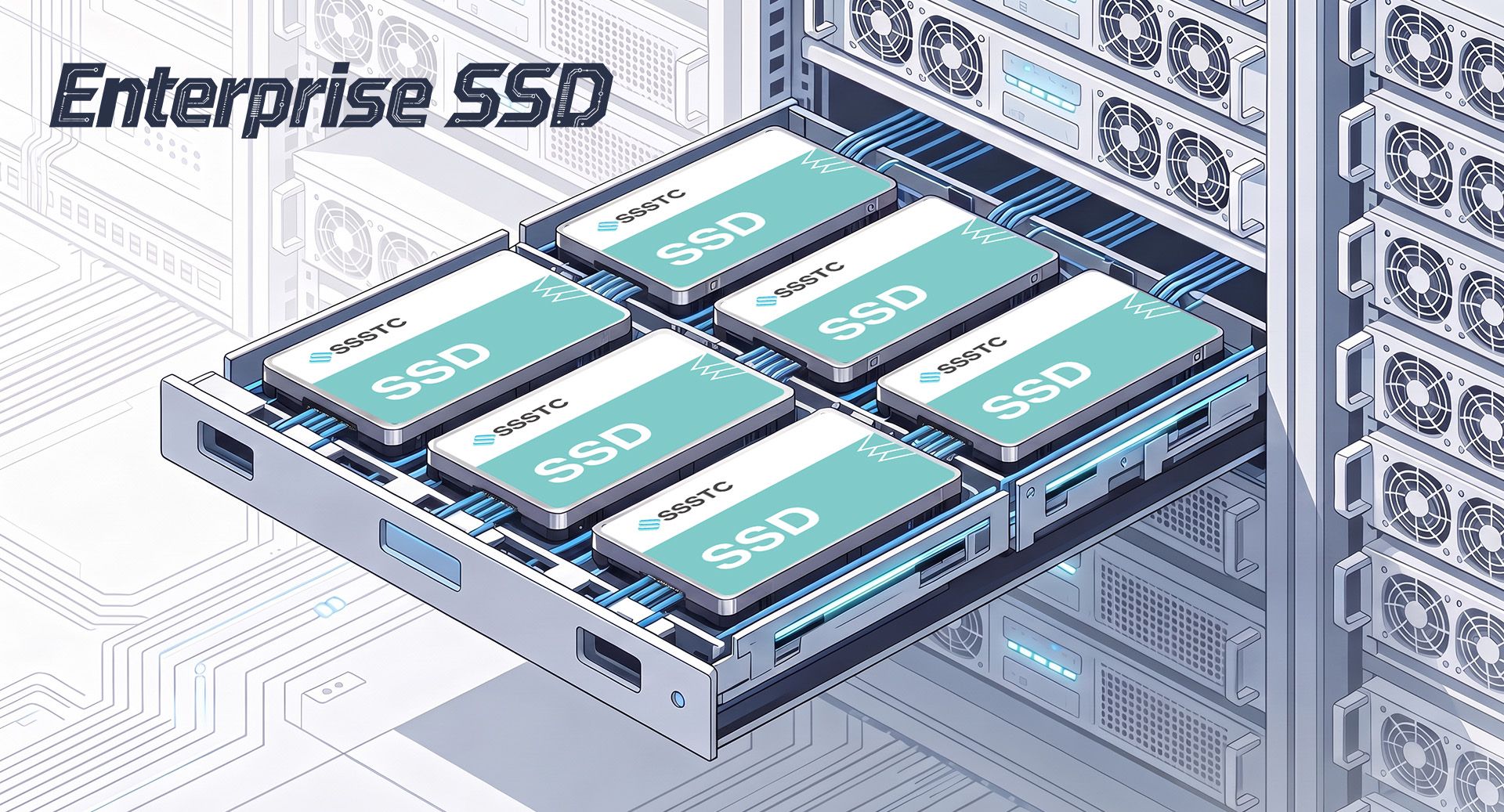
RAID and SSDs: The Challenge of Balancing Performance and Reliability
RAID combines multiple SSDs into a logical storage volume to provide fault tolerance, such as RAID 1, RAID 5, and RAID 6; performance enhancement, such as RAID 0; or a combination of both, such as RAID 10. Depending on the RAID architecture, the RAID controller distributes, mirrors, or calculates parity data while continuously performing read and write operations across the SSDs. This means SSDs in a RAID environment may be subject to:
-
Sustained, high-frequency I/O operations
-
Synchronized writes and data parity operations across multiple SSDs
-
Heavy I/O workloads during RAID rebuilds
These conditions place greater demands on SSD endurance, performance consistency, and data protection capabilities. RAID stability still depends on the quality and characteristics of the underlying storage devices. If an SSD is inherently unstable, RAID alone cannot eliminate the risk of performance bottlenecks, unexpected slowdowns, or data integrity issues.
Can Consumer SSDs Be Used in RAID?
Consumer SSDs are generally not designed primarily for 24/7 high-load operation, sustained heavy writes, or strict latency consistency. When used in RAID, they may present the following potential risks:
-
Uneven device endurance may lead to more frequent RAID rebuilds, affecting system stability and availability
-
Controller overheating or thermal throttling may create performance bottlenecks
-
The lack of PLP may increase the risk of data inconsistency or even RAID volume corruption
-
Incomplete S.M.A.R.T. information or limited monitoring capabilities may make it more difficult to predict drive failures
In a RAID deployment, every SSD is a critical component. If one drive fails or behaves abnormally, the impact can extend to overall data availability and system operation efficiency.
Why Are Enterprise SSDs Recommended for RAID?
Enterprise SSDs offer several key advantages for RAID environments:-
Consistent Performance and Latency
During RAID operation, particularly in configurations such as RAID 1, RAID 5, and RAID 10, the system may generate substantial synchronized writes, mirroring operations, and parity processing. This places greater demands on SSD performance consistency. If one SSD experiences reduced write performance or abnormal latency, it can slow overall I/O efficiency and cause delays or interruptions across the RAID array.
Consumer SSDs are often optimized for high peak performance and can deliver strong read/write performance over short bursts. However, they may be less suited to sustained heavy workloads. Under continuous writes or intensive random I/O, performance may fluctuate significantly, with increased latency and less consistent I/O behavior, potentially increasing the risk of data-related issues.
In comparison, enterprise SSDs generally place greater emphasis on QoS (Quality of Service), providing more stable and predictable latency and throughput across different workloads. Even during concurrent workloads or RAID rebuilds, they can maintain more consistent access performance, reducing the likelihood that a single SSD will become a bottleneck and helping improve overall RAID reliability and stability.
-
Higher Write Endurance and Lower WAF
During normal operation, SSDs perform internal data movement and garbage collection, meaning the actual amount of NAND written can be significantly higher than the original host write volume. This is known as the Write Amplification Factor (WAF).
RAID workloads can introduce additional data processing and rebuild operations, which may increase the amount of data written to SSDs. Higher write activity can accelerate NAND wear over time.
Enterprise SSDs typically incorporate optimized Over-Provisioning (OP), Wear Leveling, and endurance management mechanisms to help control write amplification and extend drive life. These characteristics make them well suited to RAID environments with sustained write-intensive workloads.
-
End-to-End Data Protection
Although RAID provides data redundancy and rebuild capabilities, silent data corruption can still occur if the SSD itself does not provide End-to-End Data Protection.
Silent Data Corruption refers to data becoming corrupted during transmission or processing without being detected and corrected in time, potentially resulting in undetected data loss or corruption.
Enterprise SSDs may incorporate End-to-End ECC (Error Correction Code) and CRC (Cyclic Redundancy Check) mechanisms to verify data integrity across different stages, from host data transfer and controller processing to buffering and final NAND programming. This can reduce the risk of data errors during data transfer and storage.
By contrast, many consumer SSDs primarily rely on ECC at the NAND level and may not provide the same level of protection across the entire internal data path. For RAID systems handling large volumes of critical data over long periods, comprehensive data protection can therefore be an important consideration.
-
Power Loss Protection
RAID is commonly deployed in data centers and other mission-critical systems where data consistency and reliability are highly important. If an SSD loses power before data has been safely written, cached data may be lost, potentially causing RAID data inconsistency or complicating recovery and rebuild operations.
Enterprise SSDs may provide Power Loss Protection (PLP), including internal capacitor-based backup power and firmware-controlled safe-write mechanisms. Some solutions may also support Power Loss Notification (PLN) provided by the host system or UPS.
When a power interruption occurs, these mechanisms can be designed to initiate the appropriate protection procedures and preserve data and metadata within the SSD according to the product's protection architecture. This can reduce the risk of data loss and help maintain data consistency within the RAID array.
RAID Rebuild Amplifies Risk — Enterprise SSDs Are Better Equipped to Handle It
RAID rebuild refers to the process of replacing a failed SSD in a RAID array and reconstructing the lost data on the replacement drive using data and redundancy information from the remaining drives, such as mirrored data or parity information.
During a RAID rebuild, the system must perform a large amount of additional I/O. This increases the overall storage workload and may also raise SSD temperatures and cause greater latency variation. Under these conditions, SSD performance consistency, endurance, and error-handling capabilities are put under greater stress.
When consumer SSDs are used, performance degradation, inconsistent latency, or limited data protection capabilities may prolong rebuild times. If another SSD fails before the rebuild is completed, the risk of data loss or rebuild failure may increase.
By comparison, enterprise SSDs typically offer higher write endurance, more consistent QoS (Quality of Service), and enhanced data protection capabilities, helping maintain more consistent performance and data integrity during RAID rebuilds and reducing the risk of RAID degradation and data corruption.
Which RAID Applications Benefit Most from Enterprise SSDs?
Enterprise SSDs should be prioritized for evaluation when a system meets one or more of the following conditions:-
Requires continuous 24/7 operation
-
Has relatively high daily write volumes
-
Runs databases, virtualization, or enterprise applications
-
Has clearly defined Tail Latency or QoS requirements
-
Must maintain service availability during RAID rebuilds
-
Could face significant business impact from unexpected power loss
-
Has strict data integrity and consistency requirements
-
Has downtime costs that significantly exceed the SSD procurement cost
Can Lightweight RAID Use Consumer SSDs?
Consumer SSDs may be considered for RAID deployments in scenarios such as:
-
Embedded systems or lightweight industrial computing devices
-
Read-intensive applications with low write frequency
-
Applications with a higher tolerance for data loss
When cost is the primary consideration, industrial SSDs with appropriate endurance and reliability may be a better choice than typical consumer SSDs, particularly where long-term operation and environmental conditions are important.
Even for lightweight RAID applications, SSDs with basic power-loss protection, such as FW PLP or PLN, should be considered to reduce the risk of data loss or RAID array issues caused by unexpected power interruptions. In addition, regular data backups remain essential for protecting critical information.
What Specifications Should You Consider When Choosing SSDs for RAID?
When planning a RAID storage system, at least the following factors should be evaluated:
| Item | Considerations |
|---|---|
| Workload | Consider the Read/Write Ratio, Random/Sequential I/O patterns, and daily write volume |
| DWPD / TBW | Determine whether the SSD can withstand the expected write volume throughout its intended service life |
| Sustained Performance | Avoid selecting SSDs based solely on short-term peak performance |
| Latency / QoS | Evaluate response time and consistency under sustained workloads |
| PLP | Reduce the risk of data or metadata inconsistency caused by unexpected power loss |
| End-to-End Protection | Strengthen data integrity across the SSD's internal data path |
| Thermal Management and Operating Temperature | Help prevent thermal throttling from affecting sustained performance |
| RAID Controller / Host Compatibility | Verify SSD, controller, firmware, and system support |
| Product Lifecycle and Supply | Enterprise and industrial systems often require longer product availability and lifecycle support |
Conclusion: RAID Performance and Reliability Depend on Both the Architecture and the Underlying SSDs
Although RAID can improve performance and provide fault tolerance, system stability ultimately depends on the capabilities of the underlying SSDs, including hardware design, firmware, and data protection mechanisms. For applications with sustained write workloads, concurrent access, and stringent data consistency requirements, enterprise SSDs can provide more consistent performance and stronger data protection, making them a solid foundation for reliable RAID operation.
SSSTC focuses on enterprise and industrial SSD development, with a portfolio featuring solutions designed for consistent performance, higher endurance, and enhanced data protection. Depending on the product, these capabilities include QoS-focused performance, End-to-End Data Protection, and power-loss protection. SSSTC can support enterprises in building more stable and reliable RAID storage architectures and improving the overall performance and data protection of mission-critical systems. For enterprise SSD deployment, RAID implementation, or technical integration requirements, contact the SSSTC team for professional support and recommendations.
SSSTC provides the best quality, competitive cost mainstream storage products with superior customized service,using KIOXIA top-quality, reputable NAND flash memory in all our SSD products.Contact us to find more enterprise SSD or industrial SSD solutions.
__24C15hqqtC.png)
__24C15wOdCC.png)








__24C05XQ2my.jpg)





__24C05fplcZ.png)
__24C05vgHYC.png)